Cost-Benefit Analysis: Paid Health Insurance Consultancy vs. Self-Research on the Internet
In an era where information is abundantly available at the click of a button, consumers often face a critical decision: should they invest in professional services or rely on free online resources? This dilemma is particularly relevant in the domain of health insurance—a complex, high-stakes financial and medical decision that can have long-term consequences. This article presents a cost-benefit analysis of spending ₹799 on a fee-based health insurance consultancy versus investing 25 to 40 man-hours in independent online research, often through biased or unauthorized sources.
Understanding the Two Approaches
The first approach involves paying a professional health insurance consultant a fixed fee—₹799 in this case—for expert guidance. Such consultants are typically trained, experienced, and affiliated with regulated entities. They analyze an individual’s medical history, financial capacity, family structure, and future healthcare needs before recommending suitable policies.
The second approach involves self-research through the internet. This includes browsing insurance websites, watching videos, reading blogs, participating in forums, and comparing policies through aggregators. While this method appears “free,” it demands significant time, effort, and cognitive energy—estimated here at 25 to 40 man-hours.
Monetary Cost Comparison
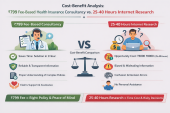
At first glance, the internet seems costless, while consultancy carries a clear price tag of ₹799. However, a deeper analysis reveals hidden costs. If we assign even a modest economic value to one’s time—say ₹200 per hour—the 25 to 40 hours spent researching equate to ₹5,000 to ₹8,000 in opportunity cost. This time could have been spent earning income, upskilling, resting, or engaging in personal activities.
In contrast, the consultancy fee is fixed and predictable. ₹799 represents a one-time expense that potentially saves dozens of hours. From a purely financial standpoint, professional consultation appears more efficient when time is factored in.
Quality and Reliability of Information
A major drawback of internet-based research is the prevalence of biased, scripted, or misleading information. Many online sources are driven by affiliate marketing, sponsorships, or hidden commissions. Articles and videos may subtly promote certain insurers while downplaying drawbacks. Additionally, unauthorized or unregulated sources may provide outdated or inaccurate details about policy terms, exclusions, and claim procedures.
A health insurance consultant, on the other hand, is accountable for the advice given. They are typically familiar with regulatory guidelines, policy fine print, and real-world claim experiences. Their recommendations are more likely to be tailored, transparent, and aligned with the consumer’s best interest rather than algorithm-driven content or marketing agendas.
Complexity of Health Insurance Policies
Health insurance is not a simple product. Policies vary in terms of coverage limits, waiting periods, pre-existing disease clauses, room rent caps, co-payments, sub-limits, network hospitals, and claim settlement ratios. A layperson may struggle to interpret these nuances correctly.
While online comparison tools exist, they often simplify or overlook critical details. Misinterpreting a single clause could result in denied claims or unexpected out-of-pocket expenses during medical emergencies. A consultant helps decode these complexities, ensuring that the consumer selects a policy that truly fits their medical and financial needs.
Risk of Decision Errors
Spending 25 to 40 hours researching does not guarantee an optimal decision. Information overload, conflicting opinions, and technical jargon can lead to confusion and poor choices. Many individuals end up either over-insuring (paying higher premiums unnecessarily) or under-insuring (choosing inadequate coverage).
A professional consultant mitigates this risk by asking the right questions and narrowing down suitable options. Their experience reduces the likelihood of costly mistakes that could outweigh the ₹799 consultancy fee many times over.
Emotional and Cognitive Cost
Decision fatigue is a real phenomenon. Long hours of research can lead to stress, frustration, and burnout. Health insurance decisions are already emotionally charged, especially when considering potential illnesses, hospitalizations, or family protection.
By delegating this task to an expert, individuals can reduce mental strain and make more confident, well-informed decisions. The psychological benefit of professional guidance, though intangible, holds significant value.
Post-Purchase Support and Claims Assistance
One of the most significant advantages of a paid consultant is ongoing support. Many consultants assist not only in policy selection but also in documentation, renewals, endorsements, and claim processing. During medical emergencies, this support can be invaluable.
Internet research, in contrast, offers no such personalized assistance. Once a policy is purchased, the individual is largely on their own when navigating claim procedures, hospital networks, or disputes with insurers.
Long-Term Financial Impact
A well-chosen health insurance policy can save lakhs in medical expenses over a lifetime. Conversely, a poorly chosen policy can result in rejected claims, financial strain, or inadequate coverage when needed most.
Spending ₹799 on expert advice can be seen as a small investment toward long-term financial security. The cost of spending 25 to 40 hours researching, combined with the risk of making a suboptimal decision, may prove far more expensive in the long run.
When Self-Research May Still Be Useful
This analysis does not suggest that online research is entirely useless. In fact, a combination of both approaches may be ideal. Individuals can use the internet to gain basic awareness and then consult a professional for final decision-making. However, relying solely on online sources—especially unauthorized or biased ones—poses significant risks.
Conclusion
From a cost-benefit perspective, paying ₹799 for a fee-based health insurance consultancy is generally more efficient, reliable, and less risky than spending 25 to 40 hours navigating potentially biased and scripted online information. While self-research offers flexibility and zero upfront monetary cost, its hidden costs—in time, accuracy, emotional burden, and potential decision errors—often outweigh its benefits.
Ultimately, health insurance is too critical a decision to be left entirely to unverified internet sources. A modest consultancy fee can provide clarity, confidence, and long-term financial protection—making it a prudent investment rather than an unnecessary expense.